Showing posts with label Tucson. Show all posts

Tuesday, August 29, 2006

Fascinating Tucson, Part Two

For the other three parts of this (one in Musings, two at the Outpost, click below:

Outpost:
Intro, Climate

In Musings: The Desert

Outpost: History and Culture

This is going to be a "fast and dirty" entry so that I can go to bed. Tucson is surrounded by four sets of mountains:

North: The Catalinas.

After lunch, the clouds start to vanish.

This is where Mount Lemmon is, with Summerhaven at the top. My very first
Round Robin Photo Challenges entry was a series on a trip up Mount Lemmon. (Speaking of which, the next Round Robin topic is "Nostalgia." Click the link for details.)

Molino Basin

Here is a shot at Molino Basin, about a quarter of the way up Mt. Lemmon Highway. The habitats at different elevations are called "sky islands," because they represent distinct ecosystems that are separate from surrounding areas. You'll find different species of birds among the aspen pines beyond Summerhaven than what you'll see in the trees at Molino.

More on Mount Lemmon:

Diary of a Day Trip, Part One

Diary of a Day Trip: Mount Lemmon, Part Two

Diary of a Day Trip: Mount Lemmon, Part Three

Diary of a Day Trip: Mount Lemmon, Part Four


East: The Rincons


The Rincons are similar to the Catalinas, but shorter and undeveloped (i.e., no roads or houses on them). They are part of Saguaro National Park East. Colossal Cave is at the Rincon end of town.

South: The Santa Ritas.


These are a bit farther away than the others, down below the airport and Davis-Monthan AFB, toward Green Valley and including Madera Canyon. There was a fire in the Santa Ritas in 2005.

West: The Tucson Mountains


The Tucsons are very different from the other three ranges, looking like a bunch of piled rocks more than anything else. (Southern California has many mountains like these.) We used to live in the foothills of the Tucson Mountains. The range separates Tucson from the Avra Valley, where the Arizona Sonora Desert Museum and Old Tucson are, and where Saguaro National Park West is. The most spectacular way from the city to Old Tucson is across Gates Pass, a steep, scary, winding road with a great scenic lookout at the top. The photo is of my dad in Gates Pass in 2005.

Karen

Technorati Tags: , , ,

Friday, August 25, 2006

Fascinating Tucson, Part One

Your Weekend Assignment #126: What is the most interesting thing about where you live? "Thing" in this case would be a famous landmark, a famous current celebrity or historical personage from your home town or county, a notable celebration or sports event -- basically, anything that makes where you're from interesting and unique.

Extra Credit: Are there any books that feature your home town (or someplace nearby) in any way?


THE most interesting thing about Tucson?  I don't think I can pick one thing. (Big surprise, huh?)  I will tell you right off the bat that it's not Flandrau Planetarium, the Diamondback bridge or the statue of Padre Kino. Nor is it the fact that Lee Marvin lived here, John Dillinger was once captured here and Linda McCartney died here.  Some Tucsonans might point to the University of Arizona basketball team, but I don't watch basketball. The Tucson Gem and Mineral Show is the largest in the country, but I don't care. No, no.  None of the suggested ways for a place to be interesting are even in the running as reasons I find Tucson interesting.

As far as I'm concerned, Tucson is most notable for the following:

  • The desert, including the critters, the cacti, the washes, etc.
  • The mountains that surround the city
  • The climate, so different from the Syracuse weather I grew up with
  • The history and culture of the place

As an experiment, I'm going to write about two of these at the Outpost, and the other two in Musings. Each of the bullet points above will have its own entry, one per blog per night.

The Desert

When we first came to Tucson in 1986, we fell in love with the desert here. It was full of interesting new birds like pyrrhuloxias and phainopeplas, curve-billed thrashers (like the one shown here) and brown towhees, and fun mammals such as coyotes and javalinas. We learned about rivers that only have visible water when it rains, and riparian habitats where water supports trees and certain kinds of birds.  We found out that a palo verde is a tree with green bark and yellow blossoms, and how an ocotillo looks very different during a rainy season (such as the monsoon) than the rest of the year. And we learned that when it starts to rain at the Arizona Sonora Desert Museum, getting under a ramada may not protect you much. A ramada is basically a roof for providing shade, and sometimes it's made of saguaro ribs (the sticks inside a saguaro cactus that hold it up) laid side by side.  That's good for shade, but it doesn't do much to block precipitation, when there is any.

A very green patch of desert in March 2004, across from the Target on Grant Rd.

Yeah, we liked the desert a lot. About two weeks after we got here, we bought a house in the foothills of the Tucson Mountains, where the desert was in our back yard.  We had saguaros and sagebrush and palo verde trees, coyotes and tortoises and javalinas and over 50 species of birds.  I like the house we're in now, but I really miss having the desert out my door.

Toward the bottom of Mount Lemmon, March 2005

On the Outpost: Climate

Tomorrow night: Mountains.

Karen

Technorati Tags: , , , ,

Wednesday, October 19, 2005

Still More Arizona Plants

I may as well tell you up front that I'll be spending most of the evening at work.  I just stopped home to see John, get dinner, check my email and, ahem, blog.  But John's not home yet.  I've finished my photo editing for the night, I'm hungry, and I really have a lot of work to do.  So I'm going to finish up my mini-series about plants in Arizona, and rush back to the office. 

Tomorrow is Weekend Assignment night.  I should be out of this mini-rut by then, if I can fit it in between an appointment with my trainer and still another evening at work!

Okay.  Cactus. 


This is a cactus, specifically a cholla.  These are particularly nasty to brush against.  Some kinds of cholla are called "jumping cholla" because people swear the thing jumped out at them - they were sure they weren't close enough to get "bit"!  There's also a small, cute variety called "teddy bear" cholla that's positively "furry" with needles.  But you wouldn't want to cuddle it.


Here are two more kinds of cactus, plus some succulants.  The three round things on the left are barrel cactus.  The yellow and red stuff on top is the fruit.  On the right, of course, is prickly pear cactus.  All but about four states have some kind of prickly pear somewhere, but they're particularly common here.

A prickly pear fruit is called a "tuna," of all things.  It's made into jelly, candy and sauces, but not by me.  I've never even tasted the stuff.


This is an aloe or agave or something.  I don't know much about these, but they're definitely desert plants.  I'm the only person I know who is probably allergic to Aloe Vera.

This photo reminds me of the nasty spaceships of the Shadows on Babylon 5.  I can't decide whether this plant looks cute or sinister here.


This is the agave plant that has made me bleed at least three times on my way into the office - including this morning.  Bad, nasty, wicked plant!


This is neither a cactus nor a succulant.  It's an ocotillo.  When the weather has been dry, it's basically a spray of tall, thorny sticks.  When it's been raining a lot, it gets green and leafy, and sometimes has red flowers at the top.

Oh, and this?  This is a rerun.  It's a saguaro on Mount Lemmon, March 13th, 2005.

Tomorrow: New Adventure.

Karen

Monday, July 25, 2005

How Cool!

Your Monday Photo Shoot: In a picture, illustrate how hot it is where you are. This can be be something as simple as a picture of a pool packed with kids, or, if you want to get really creative, something more imaginative. - J.S.

June 21st at 2 PMTonight at 7:30.

Tuffy seems happy about the wet yard.
Remember the picture on the left? This was the temperature in Tucson on June 21st. My has car said it was 110 degrees or higher every day for the past month. But not today, I think. Although the coming of the monsoon has quadrupled the relative humidity around here, the actual temperature has fallen quite a bit. The official high today was "only" 100 degrees, and it was down to 84 degrees by 6 PM. You see, it rained this evening.

It wasn't exactly a gullywasher. It rained a little bit off and on, but there was no lightning and it never poured. Still, check out the car's thermometer at 7:30 tonight. In the past I've often seen it up over 90 degrees late into the evening.

Tuffy isn't fond of thunder or lightning (no surprise there), but she seems to be pleased with the wet back yard. Maybe she'll stop knocking over her water dish for a while. We think she does it to cool her feet.

You can tell we need the rain!When we get a decent rain, there's always a puddle that lines our side of the street for a while. Yes, that's our mostly yellow-to-brown grass, and our blue mailbox. You can tell we needed the rain! We still do.

If my sunset pictures from tonight aren't the best in-town ones I've had yet, it won't be because Nature didn't cooperate. I've never seen the colors brighter. I drove around until dusk, taking a few dozen photos...okay, it was more like 50. Satisfied? I'll show you more of these tomorrow night.

The first ones here were taken in the Safeway lot again. Given the number of photos I take there, you'd think Safeway was the Eighth Wonder of the World.


Sunset at safeway, again.

color "corrected"

I allowed Microsoft Photo Manager to "correct" the color on that last one. Which do you like better, the original colors (tending toward orange) or the ones the software gave me (tending toward purple)?

Karen

Monday, March 28, 2005

Radio! Radio! Right Now!


I'm on the radio in 20 minutes! Make that 4 minutes! 8 PM MST!

http://www.publicbroadcasting.net/kxci/ppr/index.shtml

If you miss it, check the KXCI.org web site for broadcast times of "A Poet's Moment." It's one of their mini-programs, and each show is broadcast four times. Remember, all times are MST.

If you don't want to hear my less-than-dulcet voice overdramatizing my best poem, then, well, never mind. But it's a cool station, regardless of whether you hear me on it. Where else can you hear Louis Prima, Woody Guthrie, Ziggy Marley, Stan Ridgeway, Fanny, blues, Tucson artists, electronica, obscure rockabilly, equally obscure psychedelia, and classic samba?

There will be another show, with another poem. I'll let you know when he gets that one scheduled.

Later....

You missed it already, didn't you? Yes, you did! Sarah heard it. I heard it. The rest of you missed it. I understand. You didn't get adequate notice.

Like Little Rabbit Foo Foo, I'm going to give you three more chances:

Wednesday at 1 PM MST
Friday at 2 AM MST
Sunday at 2 PM MST

All times are approximate. Tonight it aired 3 minutes before the hour.

Here's the poem, in case you want to read along:

Pilate’s Answer:

“...And All Ye Need to Know”

by Karen Funk Blocher


And when they thought they needed him

For all men's grand and trivial schemes,

They hunted, leaving women home

To watch him dancing at their doors.

The men would sometimes find him, too:

An ear between two whispered words,

A hand in dying, dancing flames,

An eye that blinked in time with stars.


Soon or late, they thought they spied

An ancient foot between two growls,

And grabbing by a withered toe

They dragged him to the stadium.


In the center was a stage,

That they from every angle might

Survey and study ageless flesh:

Now young, now old, forever strange.


And one by one they came to coax,

To scream, negotiate, threaten, bribe...

While he stood smiling, mocking all,

His mouth forever smiling, shut.


And much would some of them endure

Just to glimpse his shadowed face.

They sat on nails. They cut off ears.

They starved alone among the rats.


Then many, failing, came outside

To claim that they had heard his voice,

And used his name to justify

Their good, and bad, and mad ideas.


Others, quiet in their chairs

Would paint him 'til their hands were dust,

In somber blues, in burning reds,

In glorious fluorescent tones.


A child, a sphinx, a laurel crown,

A junkie, shepherd, quiet pond

They saw in him, and in his hand

A flower, pitchfork, candle, sword.


Each night the thwarted pilgrims left,

Some early, others staying 'til

Their eyelids pressed on reddened eyes

And legs could scarcely stagger off.


And finally, when all had gone,

Truth left the stage, invading dreams

And laughing, spinning changing lies

For men to follow, blindly grateful.


Karen


Saturday, July 31, 2004

Arizona Saguaro

Someone called SmartyPantzJessi sent me this neat cactus picture for this journal.  I messed with it a little - I hope you don't mind!  I especially like the Disney-style lettering.

The state flower shown in the graphic is the flower of the Giant Saguaro, that huge cactus with arms that everyone remembers from westerns and Warner Brothers cartoons.  It takes something like 75 to 100 years for a saguaro to get big enough to get its first arm.  By then it's probably about 20 feet high. The one in the graphic would be about 20 to 30 years old, I'd estimate.

The flowers are visited by bats and birds, and the fruit that comes later is harvested by the Tohono O'Odham using long poles.  They use it to make jam, syrup and cermonial wine.  Myself, I've never tasted saguaro anything. Flickers and Gila woodpeckers make holes in the mature saguaros for nests, leaving those holes behind for later use by other animals such as tiny elf owls.  The hole gets crusted over on the inside as the saguaro heals inself, forming a saguaro "boot." Circle of life stuff, y'know?  The saguaro's main enemies are pollution, drought and people.  I hate it when I see holes in a saguaro from somebody's gun.

The other picture is a rerun from an older posting.  It was taken at our old house on Grannen Road over a decade ago. Another picture from that same property, featuring a more typical saguaro with multiple arms, can be found several entries below this one.

Karen

Saguaro National Park info page

Thursday, July 29, 2004

Happy Anniversary, AOL-J! Welcome to Tucson!

photo by JBlocherHappy Anniversary, AOL J-Land!  As part of the festivities, I now present a time-traveling, virtual tour of Tucson, Arizona, spring 1986.
In January, 1986, John inherited some money that allowed us to put our stuff in storage in Columbus Ohio, install Jenny Dog on a mattress in the back of our newly-purchased Dodge van, and drive around the country looking for some place that it wasn't winter.  We went as far south as Key West, as far north as Montreal, and then headed west, mostly following defunct Route 66 until it was time to drop south for a visit with John's sister, Martie, in Phoenix.  We hung out there for perhaps five days, during which John bought a Chinon camera for my birthday.  Then we drove south to Tucson, ostensibly to see Old Tucson, a combination movie location and tourist attraction.

We stayed at the Ghost Ranch Lodge, a neat old place with an extensive cactus garden. On our first full day in Tucson, we went to the Arizona-Sonora Desert Museum, which is full of the animals, plants and even minerals of the Sonoran Desert.  The day clouded up.  When it started to rain and then to hail, we ran for the shelter of a ramada (basically a roof on poles).  It didn't help much.  The roof of the ramada was made of saguaro ribs, the skeletal sticks hidden inside the giant saguaro cactus.  The ramada was good at providing shade, but not so good for blocking rain and hail.

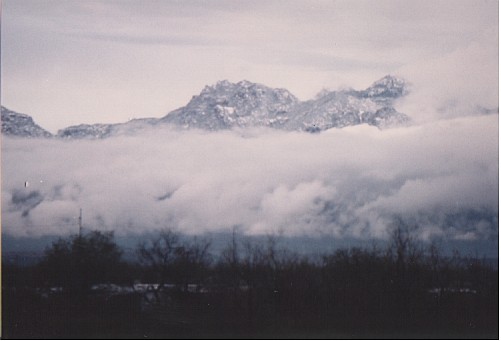
desperadosBoy, the mountains were pretty, though, when John took pictures that afternoon. The cloud hung below the top of the Catalinas (above).  We thought that was about the best "dramatic weather" (as John called it) we'd ever seen.
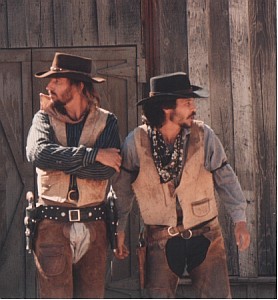
When the rain was over, we went to Old Tucson as advertised.  The desperados at the right, stars of one of the four different gunfights stages each day, were part of the show.  So were the buildings, some of them deteriorating adobe ones built for the movie Arizona in the 1930s, others suitable for gunfights, movie and tv exterior shots, or sales of food or souvenirs.  The High Chapperal was filmed at Old Tucson, and lots of films, from John Wayne vehicles to The Three Amigos. Sadly, about half of Old Tucson was destroyed by fire about a decade later, thanks to a disgruntled, mentally-ill employee. It's been rebuilt, but it just isn't making it financially any more.

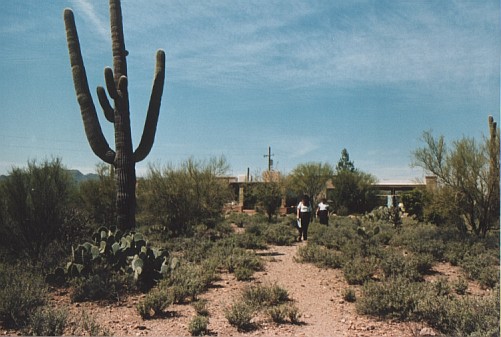
To make a long story short, we loved Tucson.  Two weeks later, John was negotiating to buy our first house as homeowners over a pay phone at Gilbert Ray campground.  We eventually had to sell that house on Grannen, but it was great while it lasted.  Below is a view from behind the house. 

Grannen, 1986
We were so taken by the whole Tucson / Arizona / western sensibility that we bought western shirts and hats (I got my black Silverado hat at a mall in Albuquerque), and even went to an NCAA rodeo competition at Old Tucson. Here is a picture of John "gone native," standing in front of a saguaro. In case you're wondering, no, he doesn't smoke cigars anymore. We still have the hats, though. I also have some gray cowboy boots that cannot be worn without pain--at least, not by me. 

Judging from the placement of the photo in the album, I probably took the picture of John right after our first trip to Tombstone, site of the famous shootout between the Earps and the Clantons. But that's another story.


John goes native, 1986 I heard Arizona Governer Janet Napolitano say yesterday that Arizona's population (if I recall correctly) has gone up 40% per decade.  An amusing, mostly-true book called Arizona 101 says that most people in Arizona would like the borders to have been closed right after they arrived, just to preserve what's uniquely Arizona from overdevelopment.  Well, there's still lots of desert in Arizona, but it's very true that things have changed since we got here in 1986.  Hardly anyone wears a cowboy hat any more, except during Rodeo Days, which are still a school holiday in March. Valley National Bank is now Bank One, Ev Meacham is long gone from the governorship, thank goodness, and Indian jewelry stores and IBM have given way to call centers and companies built around optics or defense contracting.  It's still a pretty neat place, though. And you are (virtually) there!

Karen

P.S. Thanks, everyone, for stopping by.
Wednesday, July 28, 2004

Gullywasher!


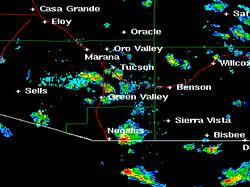
source: NWSThis is more like it.  We've had significant rain most of the afternoon here in midtown Tucson, real monsoon activity instead of just rain over the mountains.  At least one major city street was briefly closed due to flooding. With any luck, I'll find water actually flowing in a wash once I get off work, and get you a couple of pictures.
Just this past Sunday, Father John Smith pointed out in a sermon that the rain one person prays to avoid (say, the day of a family picnic) may be the same rain someone else (say, a farmer in the drought-starved Southwest) prays to get.  I was reminded of this as I reveled in today's rain, only to learn that a  nearby town had major rain damage.  Someone was even injured when his mobile home collapsed.  I heard this on the radio, but missed the details as to where exactly this was. Needless to say, I didn't want anyone to get hurt, or for a family to lose their home!

Karen

photo by KFBLater:

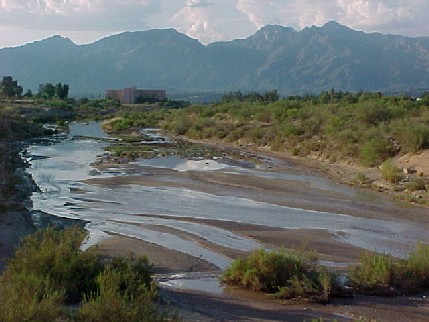
It was pretty dry at the east end of town by the time I got home, but there was water flowing in Pantano Wash.  Here's the best of the pictures. Usually there's no water in this semi-retired river, except right after rain. As I understand it, water used to flow in some of Tucson's rivers (notably the Sata Cruz) over a century ago. Overgrazing and other man-made changes to the local water table soon put a stop to that.

The next time there's significant weather before dark, I'll try again for some pictures.

KFB

Wednesday, July 14, 2004

The Monsoon in Color

NOAA GOES image WCI 17
Here's what the monsoon looks like, according to NOAA (National Oceanic and Atmospheric Administration). Now that's more like it. It rained much of yesterday evening in Tucson, and it will rain more today. Finally.  It supposedly rained over an inch in the last day or so, which is roughly 1/12th of the average rainfall for the year.

I don't quite follow NOAA's terse explanation of the color scheme on this satellite photo / map, but I think the most colorful bits are colder and wetter. Tucson is roughly in the gray spot in the southeast quarter of Arizona (that colorful state just east of California).

No pictures from me today, even though the cloudy Catalinas were highly photogenic this morning.  The digital camera is recharging, and I'm up against the final deadlines on all my homework. Plus today is payroll day at work, so I'll be busy here, too.

Karen

Tucson, Rain & Those Hazy Crazy Memories of Summer
Fire on the Mountain - More on the Monsoon
Clouds' Illusions
Monsoon Watch: One Step Back....

National Weather Service - Tucson monsoon page
National Weather Service - Tucson forecast

Tuesday, July 13, 2004

Momentary Monsoon

This year, the arcane standards of the National Weather Service that determine when the Arizona monsoon starts proved to be less demanding than mine are. As of today, their page about the monsoon says that it started last Thursday, July 8th.  I, on the other hand, was trying to hold out for actual rain in the city of Tucson itself, which is to say, any place I happened to be at the time. Not a few raindrops, but rain.  A gullywasher.  Or, more to the point, a car washer.

Today, I finally got that.  For all of five minutes.  At 3:30 this afternoon near Broadway and Country Club, there was thunder. There was a downpour. There were people staring out the window. There was minor flooding in the street. But by the time I left for the bank ten minutes later, all that was left was a little rain in the street plus a light sprinkle.  Phooey.

Maybe tomorrow. Meanwhile, here's a picture taken around dusk tonight, looking east from Park Place shopping mall toward rain on the Rincons.

It's almost 8:30 PM now, and I just heard thunder.

Karen


Tucson, Rain & Those Hazy Crazy Memories of Summer
Fire on the Mountain - More on the Monsoon
National Weather Service - Tucson monsoon page
National Weather Service - Tucson forecast

Sunday, July 11, 2004

Monsoon Watch: One Step Back, and Forward Again

When I started out to church this morning, there was hardly a cloud in the sky. Now they're building up again over the mountains, mounds of white puffy promise that make the Catalinas and the Rincons look small.  But overhead, the sky is perfectly blue and clear. I'll be very surprised if it rains today.

I liked blue sky
Back in Syracuse, but now
I need rain instead.

Stay tuned.

Karen

Later that same day...

What was I saying about no cloudage overhead?

At 7 PM I heard thunder!  I grabbed the camera and rushed outside, walking to the end of the block and back by way of the alley. A few tiny droplets of rain fell on me, my eyes got all gritty from a brief duststorm, and I just missed getting pictures of lightning about three times.  No gullywasher yet, but it's coming.  The thunder promises.

Up the block, a neighbor I don't know at all stood propped up against his truck, shirt off, camera to his eye, trying for lightning pictures.  I wished him luck with it.  Across the street, a couple with two dogs hugged and watched the sky.

Come on, come on...!


Promise, sunset clouds
You will not slip off at dusk
And leave the earth dry.

But they did.

Karen

Tucson, Rain & Those Hazy Crazy Memories of Summer
Fire on the Mountain - More on the Monsoon
National Weather Service - Tucson monsoon page
National Weather Service - Tucson forecast

Tuesday, June 29, 2004

Fire on the Mountain - More on the Monsoon

Fire over TucsonHave you ever noticed that the longer you live somewhere, the fewer pictures you take of it? John and I have been in Tucson since 1986, and the vast majority of our pictures of the place were taken from 1986-1990. These days, most of our pictures are taken by digital camera, someplace else.

I went looking for more pictures of dramatic weather in Tucson, but the notebooks are in the bedroom and John's asleep. I sneaked in (snuck?) and got a couple of neat pictures, though, to illustrate further explanations about the Tucson monsoon and the season that immediately precedes the summer monsoon: fire season.

The two pictures here are of a particularly bad fire on Mount Lemmon, circa 1988-1990. Mount Lemmon is part of the Catalina Mountains, which form the northern boundary of Tucson. If you think this fire is dramatic, let me tell you: the one in June and July, 2003 was much worse. It wasn't as visible from the city, but it did much more damage on the mountain, and ruined Tucson's air quality for weeks.fire on the mountain


Now it's fire season again, and there are restrictions on campfires and smoking in National Forest lands all over Arizona. Most of the worst fires in recent years, including the one that destroyed most of Summerhaven on Mount Lemmon, were caused by humans. At the moment, though, the fires around the state mostly seem to be caused by lightning--lightning, but no rain. Remember, it's a dry heat.

It's been clouding up, though, and I found more evidence of minimal overnight rain on my windshield this morning. So now we've got both heat (high 90s to low 100s) and humidity--not at Houston levels, but more than the 11% humidity we get in April and May.

Cheyenne checks out 'Cassional Creek

There's a formula the weather people use to tell us whether the monsoon has arrived, involving so many days of a certain dewpoint level, or something like that. We don't really need to know the details. It's pretty clear to everyone in Tucson that the monsoon has not yet arrived. And I've lost track of whether it's supposed to be El Niño or La Niña or neither this time around. I never could keep those straight, anyway.

In a previous entry I mentioned arroyos, those dry washes that channel muddy, fast-moving water during and immediately after a big rain. Here's one of them, next to our old house on Grannen Road. I used to call it 'Cassional Creek. The dog who's checking it out is either a neighbor dog, Cheyenne, or Kirby, who belonged to John's business partner, Walt.

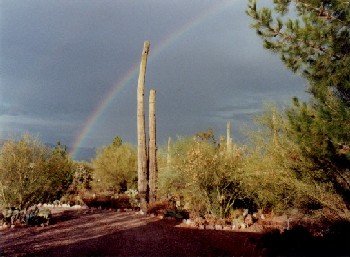
To finish things off for now, here's a rainbow over the desert, just off Grannen Road.

rainbow saguaroI'll save the pictures of Tucson's only recorded White Christmas for another time.

Karen


National Weather Service - Tucson Monsoon page

Friday, June 25, 2004

Arizona, Rain and Those Hazy-Crazy Memories of Summer

Flash flood at Old Tucson, circa 1987. Photo by KFB.

Here’s my response to another weekend assignment from John M Scalzi in By The Way....  He wants "the perfect summer song."  I'll give you two of them that work for me personally--and I can pretty much guarantee they won't be anyone else's picks.

Probably nobody under the age of 40 even remembers Nat "King" Cole's Those Lazy-Hazy-Crazy Days of Summer.  I'm 47, and I remember it fondly.  I distinctly recall hearing it on WSYR radio in my mom's Rambler as we drove past the pharmacy near the bottom of High Bridge Road in Dewitt, NY, on our way to a vacation on Lake Ontario.  WSYR was the Syracuse station for my parents' generation, and they controlled the radio on family vacations.  I didn't really start listening to the Top 40 rock stations (WNDR and WOLF) until the early 1970s.

My other specific memory of Nat "King" Cole's 1963 summer hit is from years later.  I was at the home of  some friend of my mom's, hanging out with other kids I didn't know well.  The parents were off in another room or out to dinner or something.  I came across a 45 of Those Lazy-Hazy-Crazy Days of Summer, and played it at least once.  My memory is that I did so while reading the original hardback edition of The Beatles' Illustrated Lyrics, a book that belonged to my mom's friend (Anita? Jean? Lillian? I don't remember which). 

It wasn't the first time I'd looked at that book while at that particular house.  The first time I saw it, I had Peggy Lee's Siamese Cat Song stuck in my head because of the lady's two (you guessed it) Siamese cats.  I'm sure I learned the song from an episode of Walt Disney's Wonderful World of Color. 

Anyway, the second or third time I spent an hour or more looking over The Beatles' Illustrated Lyrics, the woman loaned it to me to take home.  I still have it, that very copy, along with a copy of The Little Prince that was also originally loaned to me by a friend of my mom's.  Sorry about that.  I would have returned them 35 years ago given the opportunity.  I suspect that at some point, the books' original owners decided to let me keep them.

Now that I've confessed to my illicit possession of that Beatles book, I should name one of their songs as an alternate summer song in case only rock and roll counts.  All right: Rain.  No, it doesn't mention summer, but it's perfectly appropriate for summer in Tucson, where there are no beaches and no sane person dives with the top down in July or August.  A hot wind when it's 100 degrees or higher is not refreshing. Rain, though, can be very refreshing in such circumstances.

"Wait a minute," you may be saying. "Tucson?  Rain?  Isn't Tucson in the desert, a place reputed to have 360 sunny days a year?"

That's right.  But twice a year, it starts to rain for a month or two, not every day, but enough to get almost all of our 11 inches a year into two brief periods.  Each season is called a monsoon, after similar weather patterns on the other side of the world.  One is called the "male" monsoon, and the other the "female" one--at least, they used to be. The winter rainy season is no big deal, just a bit of rain now and then, with a little hail or snow mixed in once every couple of years.  It's in summer that we get the real monsoon.  It starts in June or July, and it's a big show: dramatic thunderstorms, lightning, pouring rain, and flooded roads.  Tucson Boulevard turns into a river.  People drive into washes (small river beds, also called arroyos, that are dry except during major storms) and get stuck or float away.  When someone unwisely drives into a dip in the road and has to be rescued, the city bills them for the cost.  It's called the "Stupid Motorist Law."

The coolest thing about the summer monsoon is that it's like the weather in the song Camelot. It usually only rains between four and six PM, or at night.  Late in the afternoon, I hear the rain pounding on the roof, and rush to the window to admire the downpour.  By the time my work day finishes, it's all over, and I can drive home. The temperature has just dropped at least 20 degrees.

Anyway, here it is late June, and everyone in Tucson is waiting for the monsoon to start.  So far we've only had a few drops when we weren't looking, just enough to make the cars filthy. When the rain comes, we'll run and hide our heads, only to watch the show from the safety of our homes and offices.

What's that, John?  You also want a song for the last day of summer?  Okay, with cooler weather only a month away--sometime in October--it will finally be time to listen to the Beach Boys, Fun Fun Fun.

Have a nice summer. 

Karen

fun facts about the Tucson monsoon - NWS